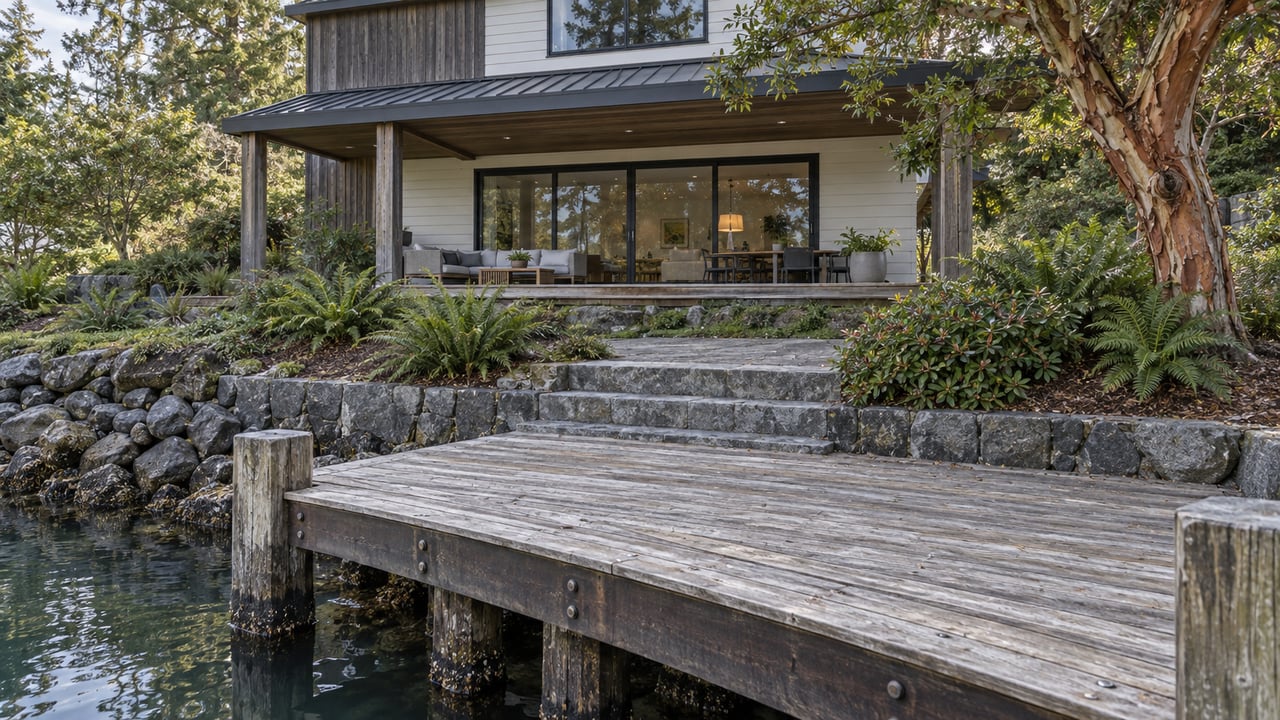
A homeowner on Wollochet Bay pulls a few rotted boards off the dock, prices out cedar decking and new hardware, and lands somewhere around three thousand dollars. Whether that work needs paperwork depends on whether it qualifies as ordinary maintenance or crosses into construction or replacement. On this particular stretch of water, that distinction matters.
Gig Harbor sits entirely on salt water, and Pierce County's shoreline code treats salt water differently than it treats a lake. For salt-water docks, $2,500 is the threshold for full Shoreline Substantial Development Permit review of new construction, replacement, and non-exempt repair work. For work subject to the threshold, crossing that amount moves the project into the same permitting track as a much larger piece of construction. For anyone buying or selling waterfront on this peninsula, that single figure changes how a listing should be prepared and how a buyer should read what is already in place.
A Threshold Set for Bays, Not Lakes
Pierce County Code 18S.60.020 spells out two categories. In fresh water, a new dock can run up to $10,000 and a replacement dock up to $20,000 in fair market value before it needs a full permit. In salt water, the ceiling is $2,500. The code defines salt water as the tidally influenced marine and estuarine water areas of the state, including Puget Sound and all bays and inlets associated with it. That language covers Gig Harbor Bay itself along with Wollochet Bay, Horsehead Bay, and the Rosedale and Kopachuck shoreline further out toward Henderson Bay and Purdy. Every one of those addresses falls under the tighter number, regardless of price point.
The gap is not a drafting accident. A House bill report says a bill passed in 2013 and 2014 raised the freshwater dock threshold specifically, leaving the salt water figure untouched. Lawmakers wanted to make it easier to build and repair docks on inland lakes using better materials, while keeping tighter review over marine shorelines where eelgrass beds, forage fish spawning areas, and shellfish habitat are more sensitive to overwater structures and new pilings. Pierce County's own shoreline planning notes point to exactly those concerns, flagging eelgrass and forage fish mapping near Horsehead Bay as a factor in dock siting decisions. The stricter number on salt water is a habitat protection built directly into the fee schedule.
Where Maintenance Ends and Construction Begins
Not every dollar spent on a dock counts against that $2,500 line. Ordinary maintenance and repair of an existing, already-permitted structure sits under a separate exemption. What pushes a project into permit territory is new construction or replacement, or non-exempt repair work whose fair market value crosses the threshold. The code also closes an obvious workaround: if a homeowner does $2,000 of work this year and another $2,000 within five years, the two projects get added together, and the combined total can trigger the same review that a single larger project would have needed.
This is worth confirming before, not after, an offer goes in. A dock that looks original and unremarkable in listing photos may have already used up its exemption headroom through work done years earlier by a previous owner, work that a new buyer would have no way to see just by walking the deck.
The city's own recent experience shows what full review looks like once a project crosses into that territory, even for a project city staff considered straightforward. In June 2026, Gig Harbor's hearing examiner heard the case for a new commercial fishing homeport dock system at Ancich Waterfront Park, a project the city had been developing since it purchased the dock area in 2012. The plan called for a 280-foot main walk float, multiple finger floats, and removal of the aging Jerkovich Pier, which carried old creosote piling. Hearing examiner Mark Scheibmeir called the decision easy, rating it a ten out of ten on ease of approval, but the record still included a full Shoreline Substantial Development Permit, a Major Site Plan Review, a formal SEPA environmental determination, and questions from the examiner about the specific number of environmental mitigation credits the applicants had purchased to offset the project's impact. That is the apparatus a residential dock owner enters at a smaller scale when new construction, replacement, or non-exempt repair work crosses $2,500 in salt water.
The Water You Own and the Water You Don't
A second layer sits underneath the permit question: whether the waterfront owner actually owns the beach in front of the house. The Washington Department of Ecology describes the ordinary high water mark as a physical boundary identified in the field rather than a fixed coordinate on a map.
A title commitment on a waterfront parcel will often carry exceptions or reservations tied to that boundary, and a survey that fails to locate the ordinary high water mark leaves a real gap in the file. Experience with tidal systems is a specialized skill, not a standard boundary survey. Thornton Land Surveying, headquartered in Gig Harbor with a second office operating in Port Orchard, is one of the local firms that does this kind of tideland and topographic work, and its own materials describe how often clients come in simply trying to understand what "tidelands abutting" actually means on their deed.
Same Peninsula, Different Math by Bay
The permit and tideland questions apply at every price point on this waterfront, not just the top end. Recent public sales records from 2025 put larger Horsehead Bay estates with deep-water frontage in the $2.3 million to $3.0 million range, reflecting the premium buyers pay for usable moorage and open Sound exposure. In the historic Inner Harbor, closer to Old Town, Skansie Brothers Park, and the public Jerisich Dock, footprints are smaller and more walkable, and recent example listings have placed an 80-foot no-bank parcel in that stretch between $1.3 million and $1.6 million. Wollochet Bay and the Rosedale and Kopachuck shoreline, both facing west toward the Olympics, mix low-bank beach with medium and high-bank bluff lots and price accordingly.
None of those differences change which code section governs a dock repair. A $1.3 million Inner Harbor slip and a $3 million Horsehead Bay estate sit under the identical $2,500 salt water threshold, because the code is written around the water itself, not the parcel's assessed value. The right comparison for a buyer is always bank type and moorage against bank type and moorage, not one bay's median against another's.
What Buyers and Sellers Should Have in Hand
Before a waterfront home goes on the market, or before an offer goes in on one, a few documents answer most of the questions above at once: a current survey that identifies the ordinary high water mark and any encroachments, copies of existing shoreline permits or exemption determinations for the dock and any bulkhead, a DNR lease if the structure sits over state-owned aquatic land, and records of any work done to the dock in the last five years with its fair market value noted. Where eelgrass or forage fish habitat has been mapped nearby, a recent biological survey saves both sides from a surprise later in escrow. None of this replaces a title company, a surveyor, or a permitting specialist, but having it organized before the first showing is the difference between a waterfront sale that moves on schedule and one that stalls waiting for paperwork that should have been gathered months earlier.
Does routine dock maintenance ever require a permit in Gig Harbor? Ordinary repair of an existing, already-permitted dock is generally treated as maintenance rather than new construction. The $2,500 salt water threshold applies to new dock construction or replacement, and to repair work whose fair market value crosses that figure, including work stacked with other repairs completed within the prior five years.
If you are gathering survey and permit records for a waterfront listing on Wollochet Bay, Horsehead Bay, or anywhere else on the Gig Harbor peninsula, or trying to make sense of what a dock's paperwork actually covers before you write an offer, Stephanie Patrick can walk through what's in the file and what still needs to be requested.
This article is general information, not legal, tax or financial advice. Consult a qualified professional about your situation.
